Loading your learning path…
Loading your learning path…
Completing Class 10 is a huge accomplishment, but it also leaves a lot of uncertainty as you continue your education. Many students and their families have to figure out what's next for their child and make a huge, long-term decision that will impact their choices of classes in the future, tests taken, colleges to apply to, and ultimately, which careers may be available later. This is a big decision and one that should be carefully considered, not made by running down to the first store you see after your cousin picks a class, or without regard to what “everyone” is doing.
Thankfully, there are many options available today; every Class 10 graduate in India will have four genuine pathways to achieving success after graduation from high school by the year 2026. We have provided you with a roadmap of the four options and laid out each option honestly, accurately, and without putting any unreasonable pressure on your child.
Before we discuss any specific options for moving forward with post-secondary education, the most critical factor to consider is this: there is no best or one-size-fits-all stream or program (i.e., Science is not superior to Commerce, nor is a Degree “better” than a Diploma). Each pathway will offer different combinations of benefits and drawbacks to meet each individual's unique circumstances.
The pathway you choose will depend on four different factors:
1. Your true and genuine interests - what you actually like studying; not simply what sounds impressive on paper or what your friends and family believe is correct.
2. Your talents and strengths - what subjects your marks and aptitude align with naturally.
3. How soon you want to begin earning money - some pathways offer a quick route to a salary, whereas others may take several years to realise.
4. Your ultimate goals - do you want a government job, a private career, self-employment, or to continue learning by studying abroad?
Keep these four key questions in mind as you review all your options and choose the most appropriate pathway for you based on how many of these criteria you can meet.
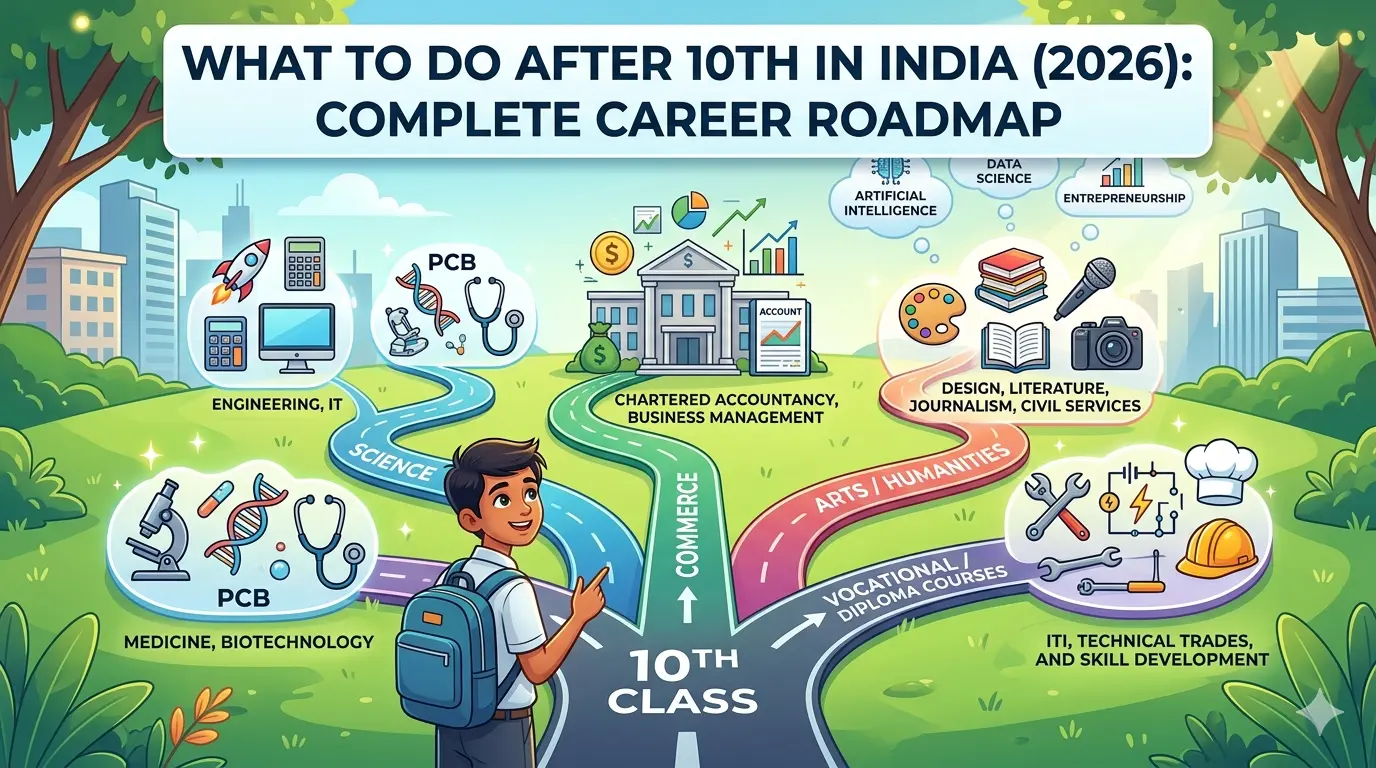
In 2026, students leaving Class 10 in India choose between four real routes:
Let's break each one down.
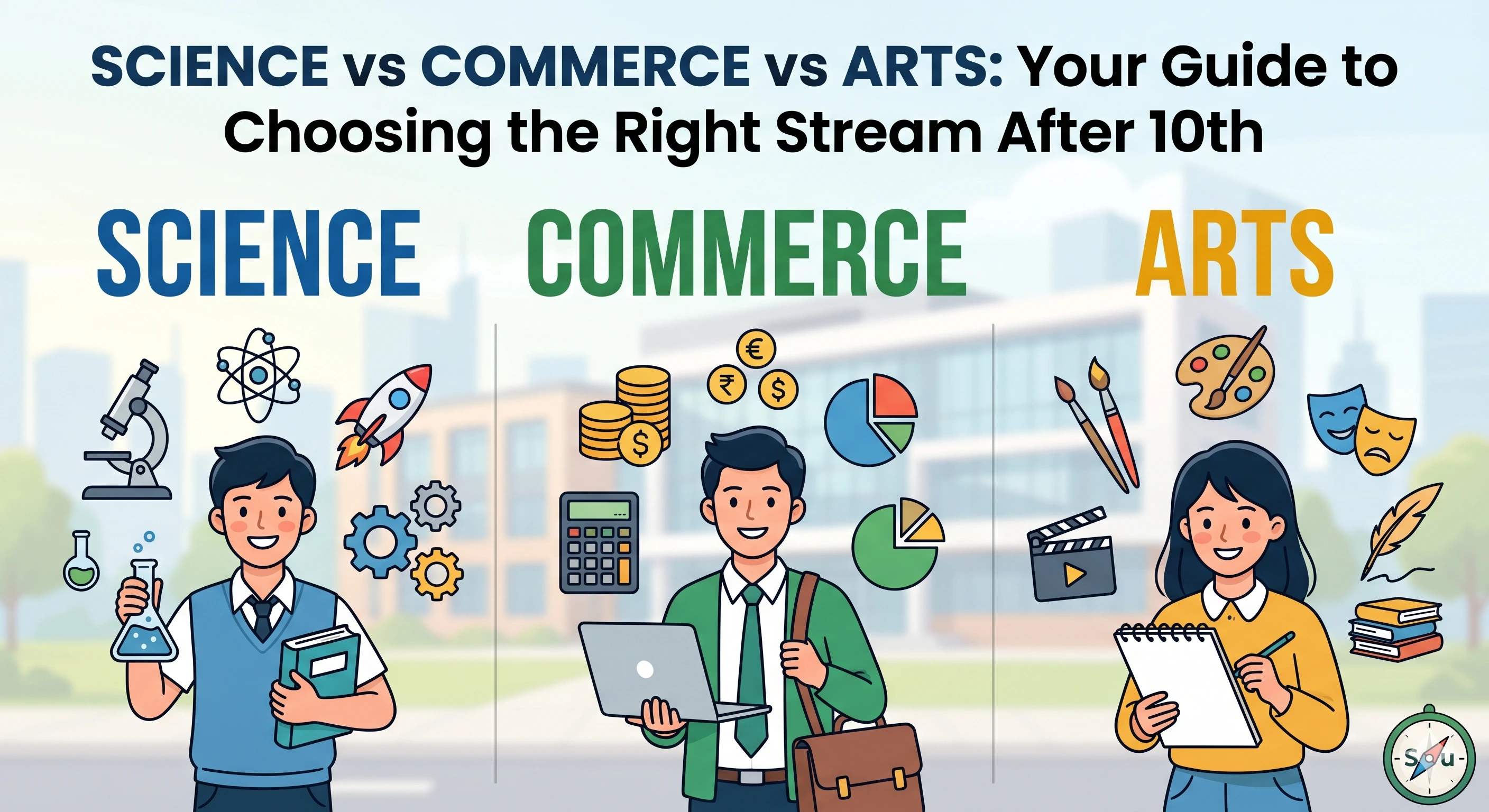
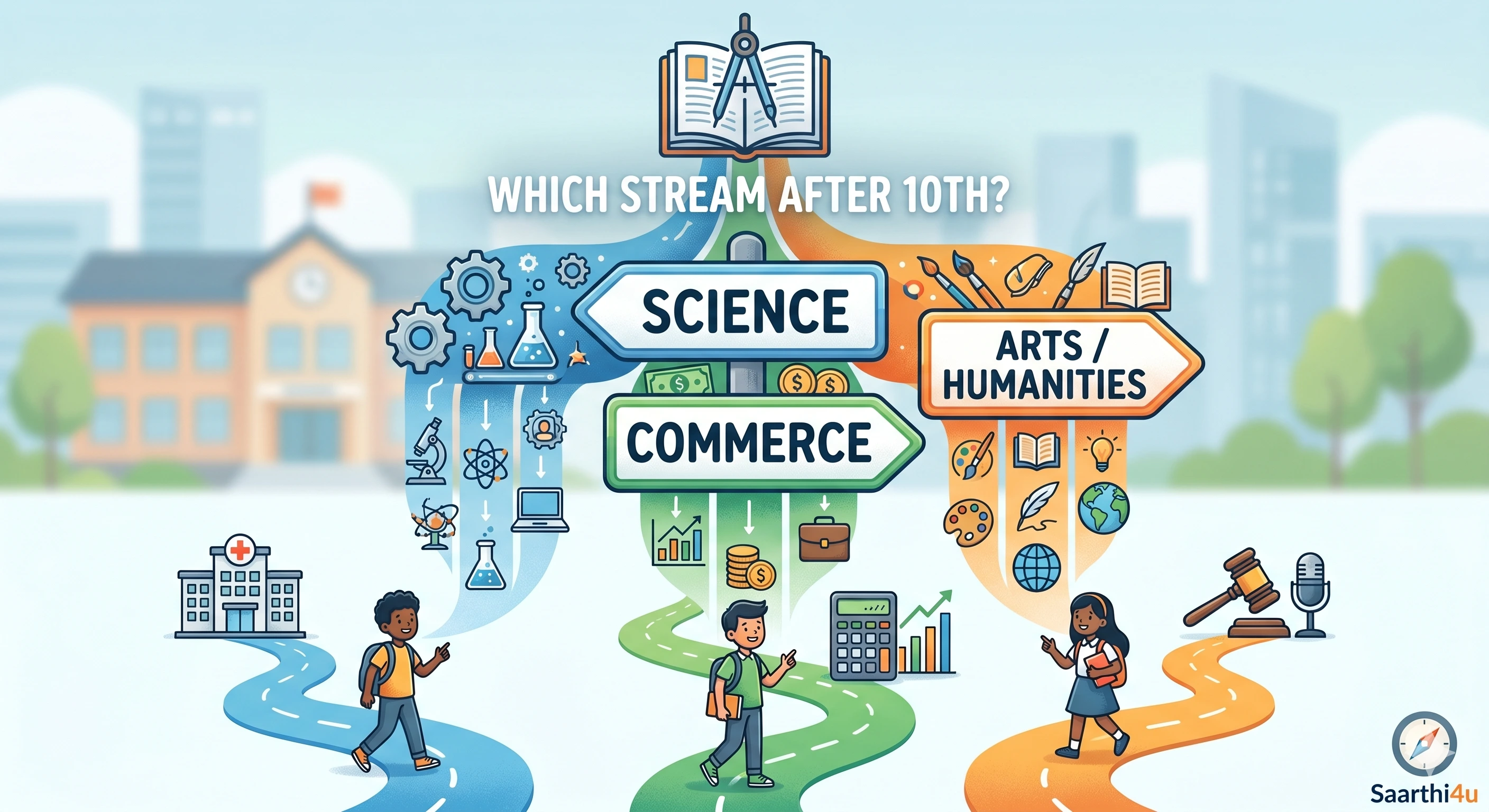
This is the path most students take, and for good reason; it keeps the widest range of professional careers open. After Class 10, you pick one of three streams.
Science suits students who enjoy mathematics, biology, problem-solving, and technical thinking. It is the gateway to engineering, medicine, research, defence, and technology careers. Most schools split Science into three combinations:
If you dream of becoming a doctor (NEET) or an engineer (JEE), Science is your route. Just remember: it is the most workload-heavy stream, so genuine interest matters more than prestige.
The Commerce stream is the right stream for students interested in Business or Finance, Economics and Management. It leads to many possible careers, including:
Students can study Commerce with Mathematics (which allows you to keep all doors open for Economics, Data, and Finance) or without Mathematics (which is a less intensive route but leads to the same opportunities for CA, Business, and Management). Therefore, choosing to study Commerce is a very smart, secure, and timely decision – and contrary to old stereotypes – will deliver a significant proportion of the highest revenue-earning professional opportunities in the Country today.
Arts or Humanities Stream
Arts is the most underrated and the most flexible Stream in India. It is a good fit for students with creative abilities, students with an interest in the social sciences, and students with an interest in communicating with people; it also opens doors for many careers that cannot be reached through either Science or Commerce, i.e., Law, Design, Journalism, Psychology, Public Service/Civil Service, Fashion, Film, and the social sciences.
Many of the most influential leaders, lawyers, civil servants and policy makers in India today are the product of a Humanities education. If you are a student who enjoys reading, writing, debating, or understanding the people and society around you, do not allow anyone to discourage you from considering the Arts Stream as a potential post-secondary pathway.
If you're certain that the only kind of career you'd like to work in is a technical industry or engineering-related one, and you want to start getting paid as soon as possible, then an excellent way for you to do so would be by completing a 3-year polytechnic diploma program instead of going through Class 11 and 12. Once you have completed your 10th-grade studies, you can enter directly into the polytechnic program, which is a hands-on training program that focuses on teaching you practical skills instead of theoretical knowledge.
India has over 4300 polytechnic colleges as of 2026, and these institutions are split between public governmental agencies and private companies. You also have the option of choosing from many different types of engineering diplomas, including Mechanical Engineering, Civil Engineering, Electrical Engineering, Computer Engineering, Automobile Engineering, and Electronics Engineering.
If you complete your diploma, then you will have the ability to move into a 2nd year via lateral entry into the 4-year B.Tech degree programs (using state-level entrance exams such as JEECUP, AP POLYCET and Delhi CET), so you can earn income while upgrading your diploma to a full degree later on if that is something that interests you.
If you want to get a job as soon as possible with practical skills after leaving school, you can do it at an Industrial Training Institute (ITI). There are more than 14000 ITIs in India that have courses ranging from 6 months to 2 years. Some of the more common trades you will find at an ITI include electrician, fitter, welder and mechanic, but you will also see a growing interest in future-focused skills such as EV (electric vehicle) Technician training.
In addition to the above ITI programs, there are a large number of other short vocational and skill development courses that you can take, which will also prepare you for a career quickly; many are job-ready by the time you finish. Some of the more popular categories of vocational and short courses include Tally with
These types of courses can provide you with the skills and experience you need to find a job quickly and are relatively affordable compared to other career options. Most importantly, they provide a pathway to higher education after you have originally completed your training, so you will never be stranded in your career choices.
Several stable government opportunities are open to 10th-pass candidates, including roles in the railways, defence support services, and state-level posts. These suits suit students who value job security and want to begin a government career early. This route usually works best when combined with continued study (such as completing 12th privately) to keep promotions and higher posts within reach.
Theory is easy; the real decision is harder. Here is a simple, practical process:
Your support at this stage is priceless, and so is your restraint. The strongest thing you can do is help your child explore, not just comply. Ask questions instead of giving instructions. Celebrate effort over a single stream's prestige. A motivated student in the "right-for-them" path will always outperform an unhappy student in a "prestigious" one.
Your future does not begin at Class 10. It is the first step into a new world and the potential for discovery of who you really are. You can follow one of only 3 paths after Class 10 (Science, Commerce or Arts) or choose to pursue a polytechnic diploma, ITI trade or work in one of many government jobs. All of these pathways will be successful and fulfilling regardless of which one you choose. The only choice that you will regret is the one made out of fear or to please someone else.
Take your time and ask lots of questions to ensure you find the right path for you which is true to yourself. Once you make your decision and can see clearly the right choice for you, everything will fall into place.
Choosing between paths after 10th-Grade becomes easier with the help of professionals. Saarthi4u's career counsellors assist students and their parents as they transition from confusion to making a confident decision that is right for them, supported by data on colleges, courses, and careers.