Loading your learning path…
Loading your learning path…
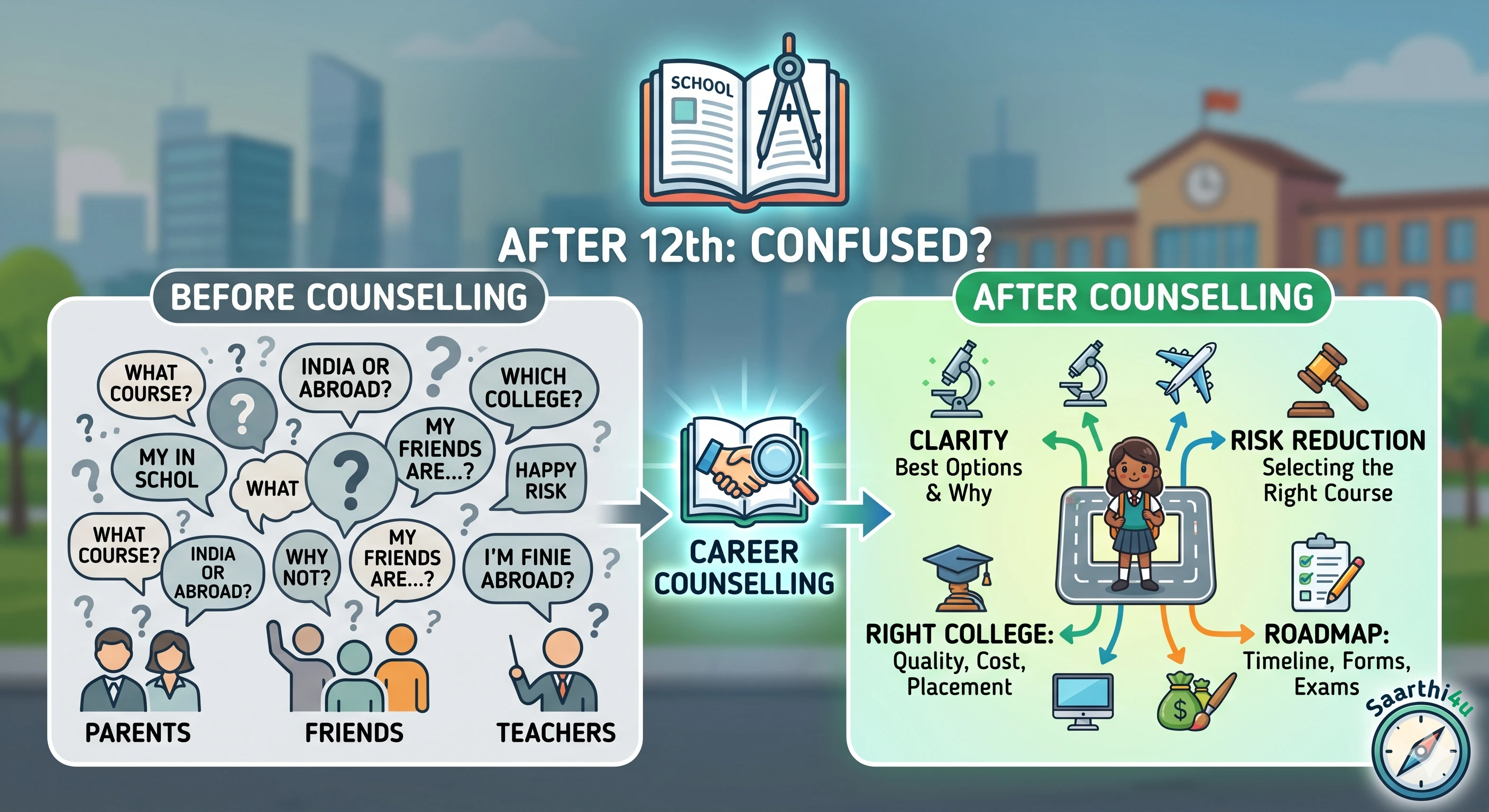
In high school, graduating from class 12 is a big change for students. Students usually make decisions about their education based on what they're taught in school, by their parents, by their teachers, from tuition classes, and from taking board tests. But after graduating from high school, students must start making decisions that will affect many aspects of their lives, potentially over several years. Examples include:
These are common questions students have as they prepare for class 12 graduation and often result in creating confusion for both students and parents due to the stress caused by conflicting opinions from family members, friends, the internet, etc.
This is where seeking career counselling is critical after graduating from class 12 to help students gain a newfound understanding of themselves through interactive assessments, a multitude of career options, and assistance in determining their best course of action, rather than just feeling pressured to decide.
Career counselling after 12th is all about helping students select the best career option, course, school and admission route for them based on their likes, abilities, character, school history, objectives, and/or real-world scenario. This is not about directing a student toward a set career direction, nor is it about telling them "if you took science, then you must pursue engineering," or "if you took commerce, then you should select B.Com.". An effective career counsellor will have an understanding of who their clients are and what they want to accomplish and then guide them in the best way possible.
Career counselling usually helps answer questions like:
A good counselling session gives direction. It helps the student and parents move from confusion to a clear plan.
Making decisions about your career after finishing secondary school can be a daunting task for many young adults. So, many people have more career choices to choose from today than ever! A majority of today's workers have historically only pursued a select few "traditional" career paths (examples would include doctor, lawyer, engineer, teacher and/or government worker). Now, many workers are able to select from almost unlimited career options, many of which are very new and/or very specific in nature.
Some examples of new-age/specialised career paths include: Artificial Intelligence (AI), Data Science, Digital Marketing, Business Analytics, Aviation, Animation, Cybersecurity, Media, Finance, Liberal Arts, Sports Management, Hotel Management, Entrepreneurship and Public Policy, and the list keeps growing!
Unfortunately, for many students, having so many different career options to choose from also creates confusion. For example, if a student knows they want to work in "business" but doesn't know whether they should pursue a BBA, B.Com, Economics, Finance, Entrepreneurship or Management Studies degree to get into the business world, or if a student knows they want to work in "psychology" but doesn't know the difference between Clinical, Counselling, and Applied Psychology. So, as a result, many students often base their success on what other students are doing or what family members say to do; others take the most "popular" program of study without realising whether they are going to succeed in that program; and lastly, many students rush to register in school early to avoid the risk of not having an available seat in classes.
The problem is not a lack of options. The real problem is a lack of clarity.
Not every student needs counselling for the same reason. Some need help choosing a course. Some need help selecting colleges. Some need help convincing their parents. Some need help understanding entrance exams, scholarships, or study abroad options.
You should seriously consider career counselling if any of these situations apply.
This is one of the most common situations. A student may be confused between BBA and B.Com, engineering and design, psychology and law, India and abroad, or medical and allied health sciences. Career counselling helps compare these options properly.
It explains the course structure, career opportunities, skills required, entrance exams, future scope and practical challenges. This makes the decision easier.
Many students choose a course because their friends are choosing it. This may feel comfortable in the beginning, but it can become a problem later. Your friend’s interests, ability, family background and goals may be very different from yours.
Career counselling helps the student choose based on their own strengths, not someone else’s decision.
Sometimes parents want one career, and the student wants something completely different. Parents may want safety and stability. Students may want passion and freedom. Both sides may be right in their own way, but without proper discussion, this can create stress at home.
A counsellor helps create a balanced conversation. The student feels heard, and parents get practical information before making the final decision.
Good marks are useful, but marks alone do not decide the right career. Many high-scoring students are also confused because they have too many options. They may qualify for multiple courses and colleges, but still not know which path is best.
Career counselling helps convert marks into meaningful choices.
Not scoring as expected can feel disappointing, but it does not mean the student has no future. There are always alternative courses, colleges, entrance routes and backup plans. Career counselling helps the student look at realistic options instead of feeling stuck.
This is especially useful when students are worried about cut-offs, entrance results or admission deadlines.
After the 12th, many courses require entrance exams. Some exams are national, some are state-level, and some are college-specific. Missing the right exam can reduce admission options.
Career counselling helps students understand which exams are actually required for their preferred course and college. It also helps them plan timelines, application forms and preparation strategy.
College fees can be a major concern for many families. Apart from tuition fees, there may be hostel charges, travel, books, coaching, application fees and other expenses. Career counselling can help identify colleges, scholarships and options that match the family’s budget.
A good career decision should not only be aspirational. It should also be practical.
People often have many misconceptions about career counselling. For some reason, they often believe that career counselling is only for people who are weak students or are confused about what to do with their lives. This belief is incorrect.
Career counselling is not:
Even students with high confidence levels and who are performing well academically need career counselling to help them figure out how they should focus their lives. In many cases, students know what they like but have no idea which course, college, or plan they should pursue.
Tests can be beneficial; however, relying on one test to determine a student's future is not appropriate. A thorough career counselling process contains a combination of tests, conversation, research, practical planning, and involvement from both the student and their parent(s).
Career counselling is valuable because it changes the way students make decisions. Instead of choosing randomly, students start choosing with awareness.
Career counselling helps students compare colleges properly so they do not choose only because of the brand name or advertisement.
1. Clarity
One of the greatest advantages of career counselling is providing clarity on what you can do in life. A student who was previously saying, "I have no idea what to do" goes on to being able to say, "Here are my best options and why they are a good fit for me."
This provides both the student and the parent with reduced anxiety and increased confidence.
2. Risk of Selecting the Wrong Course
A student may waste time, money and confidence if he/she selects the wrong course. After one year, many students realise they do not like the subject for a career, or they cannot visualise themselves working in that particular industry.
Career counselling will assist the student to better understand the course before he/she goes into the admission process. The student can see ahead of time exactly what he or she will be studying, what types of skills are required, career paths that are available, and if their career choice matches their personality.
3. Right College Selection
In addition to selecting the right course, it is just as important to select the right college. In selecting a college, several factors must be considered, not just how well-known the college is.
Both students and parents should consider:
Career counselling helps students to properly compare colleges, so that they will not choose an institution based on the name of the institution or advertising, but will select based on the criteria above.
Many students lose good opportunities because they do not know the admission timeline. They miss forms, deadlines, entrance exams or document requirements.
A proper roadmap helps the student know:
This makes the admission journey much smoother.
Career decisions can create emotional pressure at home. Parents want the best for their child, but sometimes they may not know about new career options. Students may have dreams, but they may not know how practical those dreams are.
Career counselling creates a space where both sides can discuss openly. It brings facts, options and structure into the conversation.
A proper counselling session should not be random. It should follow a clear process.
Step 1: Assess the Student
The first step is to gather information about the student's personal, academic, athletic, artistic, social and career-related interests.
Step 2: Take a Career Test or Assessment
After collecting the information about the student, they can take an aptitude test, interest test or personality test. The tests will aid the student in identifying their strengths, and they will use the results of their tests to select an appropriate career.
Step 3: Meet with the Student and Parent
After the assessment has been completed, the student will meet with a career counsellor to discuss the results of the assessment and to clarify expectations with the parent.
Step 4: Explore Career Options and Required Courses
The counsellor will review the results of the assessment with the student and meet with the student to determine which career options are best suited for the student's level of education, the necessary courses required to pursue the chosen career and entrance requirements.
Step 5: Review College Options and Complete Applications
Once the student has identified which career they would like to pursue, the counsellor will review the list of colleges that are available to the student and assist in completing and submitting applications.
Step 6: Develop a Detailed Plan of Action
At the conclusion of each step, the student will have a detailed plan of action that will include a list of their chosen courses and colleges, their required entrance exams, the deadlines for all applications and all additional steps necessary to begin their career.
Parents have a significant impact on careers, but their role shouldn't include pushing the child to pursue a particular career path. Rather, they should help guide and support their child to make an informed decision about their future.
Before trying to influence their child's decision on a career, parents should think about:
When parents participate in this process, it creates a sense of responsibility and empowerment for the children.
Counselling should also be regarded as important by the student. The student must be honest, while the counsellor provides guidance (assistance). Students should not make career choices based on friends, trends, or other types of pressures. Students should be able to express their own interests, dislikes, anxieties, and future aspirations freely with their counsellor.
The student may not know all of the answers about themselves, but they need to be open to searching for them.
Saarthi4u provides support to students and their families in selecting the best career and academic paths following Grade 12. Our focus is on creating a smoother journey from uncertainty to admission as well as facilitating a clearer path through the confusion and complexity of the admission process.
Whether you are unsure of your career options, courses, colleges, entrance exams, scholarship opportunities or when to apply, Saarthi4u has a step-by-step process for guiding you to the best answer for you.
Students can access a clear, structured process for making informed career decisions rather than relying on random web searches, relatives' opinions, or last-minute decisions.
Structured guidance can also relieve some of the stress and build your confidence in your career decision-making.
Career counselling after you complete your secondary education is beneficial to many students, especially those unsure what they would like to pursue as a career based on their personal interests.
Making the right decision will relieve stress, save you time and build your self-confidence in making future choices about your career path.
Your choice of a course to take or college to attend should not be based on what your friends choose, or to please someone else, or to make a quick decision.
Be sure to take time to evaluate yourself, explore all of your options or consider alternatives, talk to your parents, and seek the advice of a professional career counsellor.
You want your future to be a positive experience; therefore, you must take the time to seek the guidance you need to have a clear direction for your future.
Confused after Class 12? Connect with Saarthi4u and take your next step with clarity and confidence.